






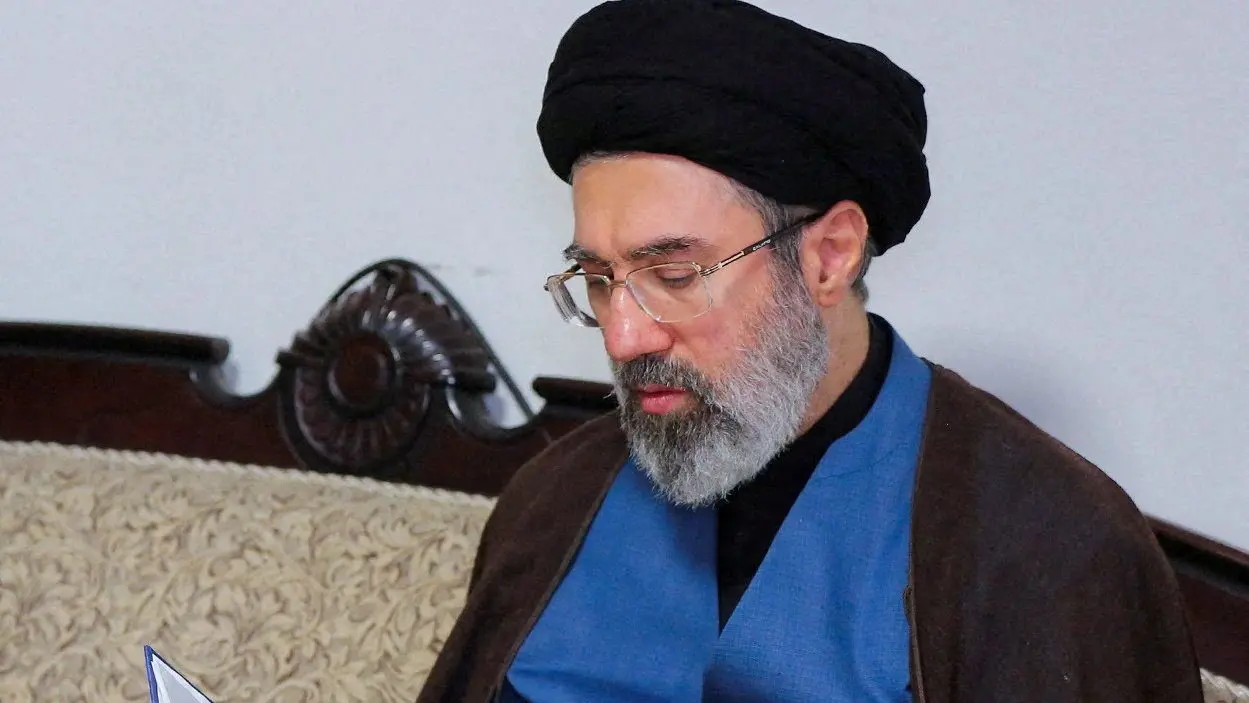
Mojtaba Khamenei, the second son of Iran's Supreme Leader Ayatollah Ali Khamenei, visits Hezbollah's office in Tehran, Iran, October 1, 2024. Office of the Iranian Supreme Leader/WANA (West Asia News Agency)/Handout via REUTERS/File Photo ATTENTION EDITORS - THIS PICTURE WAS PROVIDED BY A THIRD PARTY. THIS PICTURE WAS PROCESSED BY REUTERS TO ENHANCE QUALITY. AN UNPROCESSED VERSION HAS BEEN PROVIDED SEPARATELY. TPX IMAGES OF THE DAY
(Tehran, Iran) – Reports citing U.S. intelligence assessments claim that Mojtaba Khamenei, widely viewed as Iran’s new supreme leader, may be gay — an allegation that has quickly drawn international attention due to the country’s strict laws regarding homosexuality.
According to a report from the New York Post, unnamed intelligence sources believe Mojtaba Khamenei’s personal life could include same-sex relationships. The report did not provide publicly verifiable evidence and relies on intelligence claims that have not been independently confirmed.
Mojtaba Khamenei is the son of longtime Iranian leader Ali Khamenei and has long been seen as a powerful figure behind the scenes in Iran’s political and religious establishment. In recent years, analysts have suggested he could eventually succeed his father as the country’s supreme leader — the highest authority in Iran’s government.
The claim has generated particular interest because homosexuality is illegal in Iran and can carry severe penalties under the country’s interpretation of Islamic law. Critics of the Iranian government have pointed to the allegation as potentially highlighting contradictions within the country’s leadership, though supporters of the regime have dismissed such claims as politically motivated.
Neither Iranian officials nor Mojtaba Khamenei himself have publicly addressed the report. Intelligence claims about the personal lives of foreign leaders are often difficult to verify, and experts caution that such information can sometimes be influenced by political or geopolitical narratives.
If true, the allegation would represent a striking contrast between Iran’s leadership and the country’s strict enforcement of laws related to sexuality. However, as of now, the claims remain unconfirmed and based largely on intelligence reporting cited by the New York Post.