





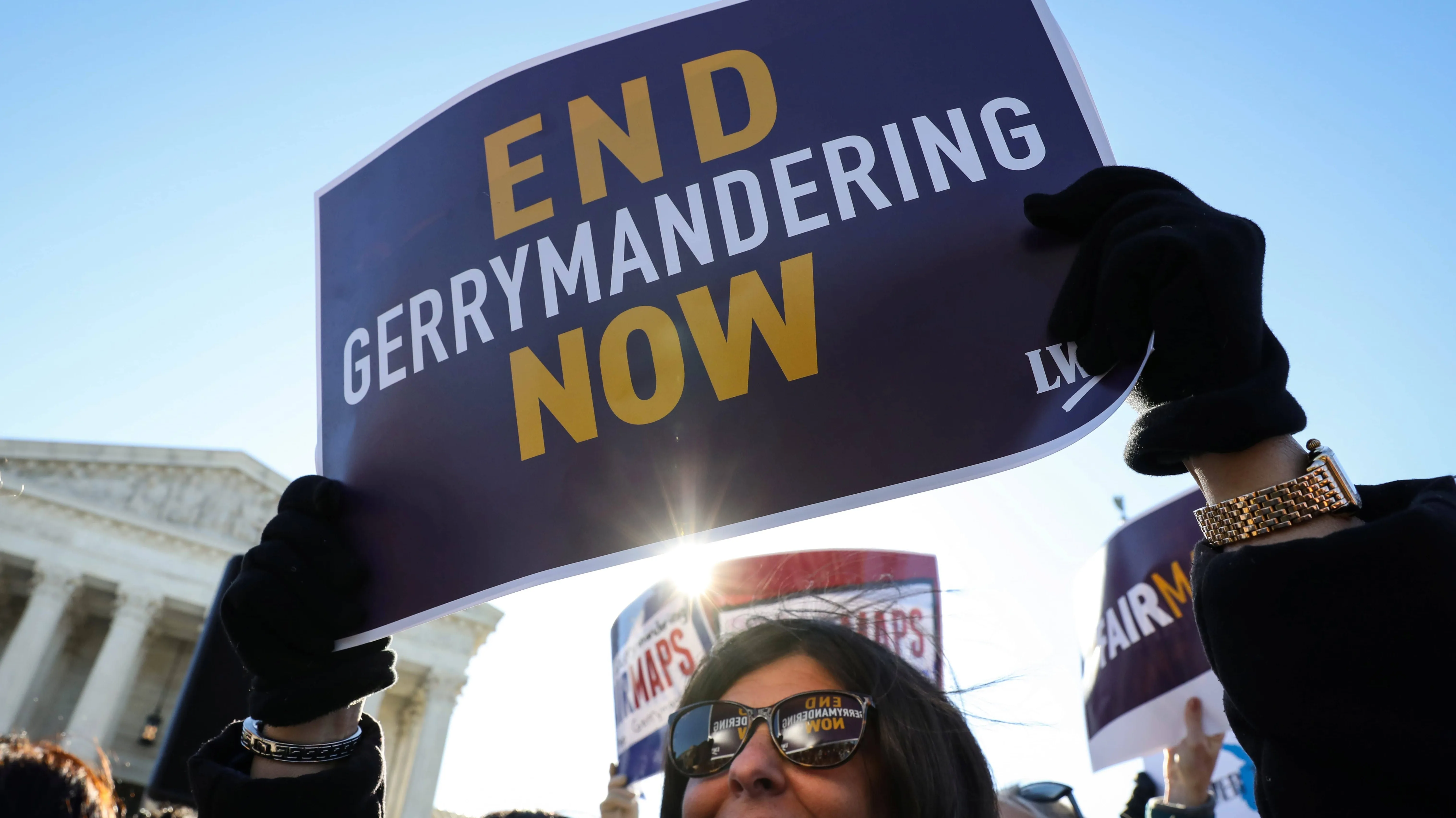
Demonstrators protest during a Fair Maps rally outside the US Supreme Court, in Washington, DC, March 26, 2019. REUTERS/Brendan McDermid
(New York, NY) – You already know the U.S. Supreme Court’s decision to strike down race as a legal criterion for forming congressional districts was one of the biggest political stories of the week.
But it’s also likely to become one of the most significant American economic stories, not just for this week but for decades to come.
That’s because the virtual ghettos race-based congressional districting creates don’t just bring about a non-competitive political environment, they produce a non-competitive business environment as well. In fact, they go hand in hand.
The gerrymandered districts produce congressional representatives with no political incentive to improve the economic lives of their constituents, because they’ll all be re-elected anyway. As a result, the only interest these modern day land barons have in new businesses is how quickly and effectively they can shake them down for money and other perks for themselves. The result is these districts have been economic “no go zones” forever. Prying them open for actual investment has been almost impossible.
Two people who tried and achieved some success against this tide were Jack Kemp and Charlie Rangel. Kemp came up with an end-run plan around these opportunity wastelands with his “enterprise zone” plans while he was the Housing Secretary in the Reagan administration in the 1980s. Rangel, who was already a long-tenured Congressman at the time, became a strong ally and personal friend to Kemp and helped push the plan to fruition in his own New York City-based district and elsewhere.
What the enterprise zones effectively did was cut taxes, regulations, and the obstacles so many greedy congressional leaders put in front of new business activity in America. Rangel, who actually never really presided over a truly racially gerrymandered district, (his district was always fairly racially mixed), knew just how badly most of his Congressional Black Caucus members were hurting their own people and he reached across the partisan aisle to do something about it.
The spirit of the Kemp enterprise zones was resurrected during President Trump’s first term and put somewhat on steroids with the administration’s “opportunity zone” program, which made a modest dent in the problem in a short time.
But end-around plans and other schemes are just band-aids on the problem. The actual crashing down of the virtual walls surrounding millions of black Americans could now happen altogether thanks to this Supreme Court decision. The simple reason is that blacks in this country could now not only be freed from the undue power over them held by feckless career politicians, but they will now likely become vital swing voters in newly drawn districts and suddenly be the focus for politicians and candidates who will actually have the incentive to do right by them in more ways than one.
Of course, that old line political establishment is working hard to portray this encouraging reality as the opposite of what it really is. The SCOTUS decision is being smeared by Democrats as racist, and disenfranchising, etc. Of all the wicked lies promoted by the American left in recent years, this may just be the most egregious. Instead of cheering the potentially most liberating development for black people in the U.S. since the 1964 Civil Rights Act, or maybe even the Emancipation Proclamation, they’re demonizing it. It’s pure evil.
But for all of this to happen, the redistricting needs to happen first. Do the Republicans and other Americans who truly care about fairness and economic potential have the will to go through with this nationwide? Or will we just see a few red states do it while blue state black communities live in the unacceptable status quo?
Something tells me that unless more of my colleagues in the news media recognize this historic moment for what it truly is, and promote it accordingly, we’ll only get a small percentage of the greatness that this court decision could bring to us all.