






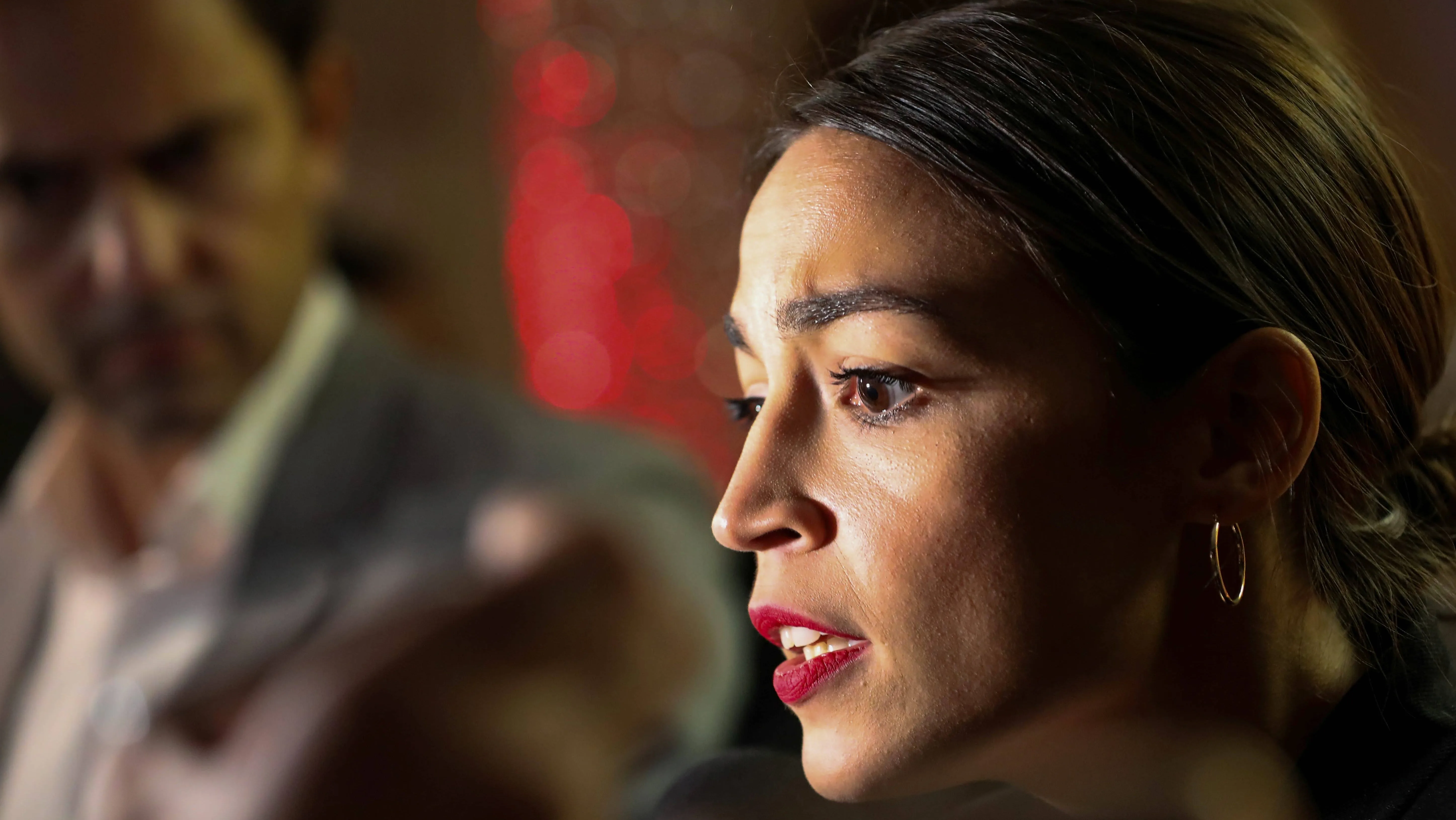
Democratic Congressional candidate Alexandria Ocasio-Cortez speaks with attendees during GOTV Rally with AOC and Biaggi in the Bronx, New York, U.S., November 1, 2018. REUTERS/Jeenah Moon
(Washington, D.C.) – Five years after January 6, 2021…
In the weeks following the Capitol riot, Alexandria Ocasio-Cortez claimed she feared she would be raped or killed as events unfolded in Washington. The story was immediately elevated by Democratic leaders and friendly media outlets, transforming personal fear into political fact and embedding her account into the official moral framework of January 6.
The problem: The Facts Never Supported the Claim.
As official timelines, security footage, and Capitol Police records were later pieced together, it became clear that Ocasio-Cortez was not inside the Capitol building when rioters entered. She was located in the Cannon House Office Building – a separate structure that was never breached by protesters that day. The “intruder” she later described as a potential attacker was, in reality, a Capitol Police officer doing his job and attempting to clear the area.
No rioters were shown to be near her office. No evidence has ever surfaced of an attempted sexual assault. No investigation corroborated the most extreme versions of her story.
Yet the narrative endured – and expanded.
Rather than clarify or correct the record, Ocasio-Cortez repeatedly leaned into the emotional power of her account, invoking it in speeches, interviews, and anniversary commemorations. Her story became less about what happened and more about what Democrats needed January 6 to mean: proof that their political opponents were not just wrong, but monstrous.
Supporters insist that fear itself is evidence – that perception overrides proximity, and emotion outranks verification. Critics argue that this standard would never be accepted outside politics. In any other context, exaggerating danger while omitting key facts would be called misleading at best, manipulative at worst.
Five years later, Ocasio-Cortez has never retracted her statements. She continues to argue that trauma does not require physical contact. That may be true – but public trust requires honesty, and the distinction between fear and fact matters when the stakes include prosecutions, censorship, and the political branding of millions of Americans.
January 6 did involve real crimes. Police officers were injured. Laws were broken. But conservatives argue that those realities were deliberately overshadowed by emotional storytelling designed to justify sweeping expansions of government power, aggressive prosecutions, and the permanent stigmatization of political dissent.
In that sense, the AOC narrative is not an outlier – it is a template. Inflate fear. Blur timelines. Amplify emotion. Silence skepticism. Repeat until it becomes history.
For the political left, January 6 has become a sacred text, immune from scrutiny. For many on the right, five years of unanswered questions have exposed how memory can be weaponized – and how easily facts are sacrificed when a story serves power.
Five years later, the riot is over.
The myth-making is not.
And the truth, like accountability, remains inconvenient…