







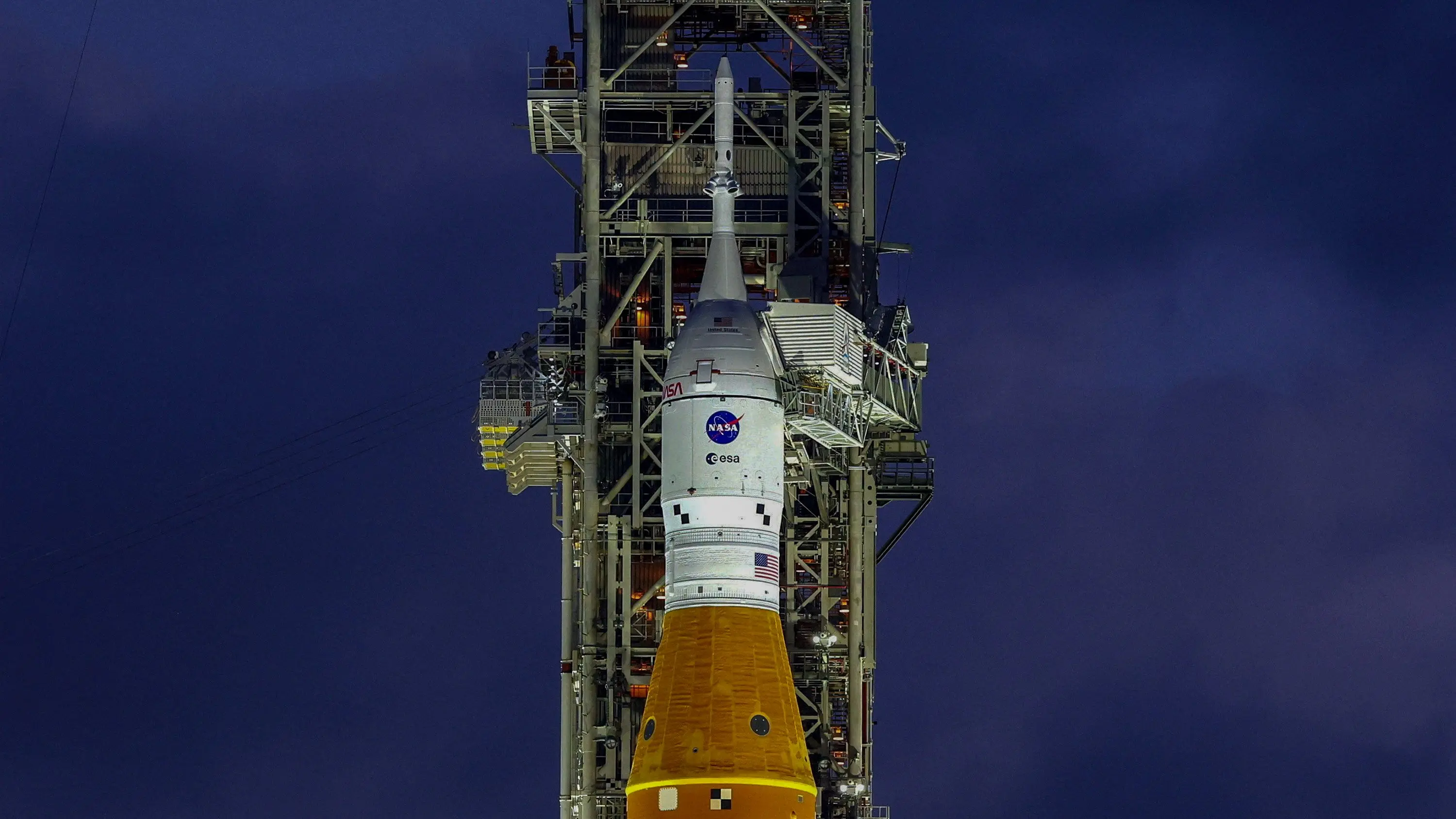
The Orion crew capsule sits atop the next-generation moon rocket, the Space Launch System (SLS) rocket, on Pad 39B ahead of the launch of NASA's Artemis II lunar flyby mission, at the Kennedy Space Center in Cape Canaveral, Florida, U.S., March 31, 2026. REUTERS/Brendan McDermid
2:00pm
Need to Know: Artemis II Launch
April 1st, 2026: 1:48pm
(Orlando, Florida) – NASA is set to make history today as it launches the Artemis II mission, sending astronauts on a journey around the moon for the first time in more than 50 years.
The mission is scheduled to lift off this evening from Kennedy Space Center, with a launch window opening at 6:24 p.m. EDT. If successful, four astronauts will embark on a roughly nine-and-a-half-day mission that will take them farther from Earth than any human crew in history.

The crew — commander Reid Wiseman, pilot Victor Glover, and mission specialists Christina Koch and Jeremy Hansen — will travel approximately 252,000 miles from Earth, looping around the far side of the moon before returning home.
Unlike the Apollo missions, Artemis II will not land on the lunar surface. Instead, it is a critical test flight designed to evaluate NASA’s spacecraft systems, safety procedures, and overall mission readiness ahead of future moon landings planned later this decade.
The astronauts have spent weeks preparing for today’s launch, including time in quarantine and following strict physical and operational routines to ensure peak performance. Meanwhile, NASA teams are monitoring weather and technical conditions, with hundreds of launch criteria needing to be met before liftoff.
The mission will use NASA’s Space Launch System rocket — the most powerful currently in operation — paired with the Orion crew capsule, both central to the agency’s long-term goal of returning humans to the moon and eventually reaching Mars.
Crowds have already gathered along Florida’s Space Coast, hoping to witness the launch in person. For many, today marks not just another rocket launch, but the beginning of a new chapter in human space exploration.