



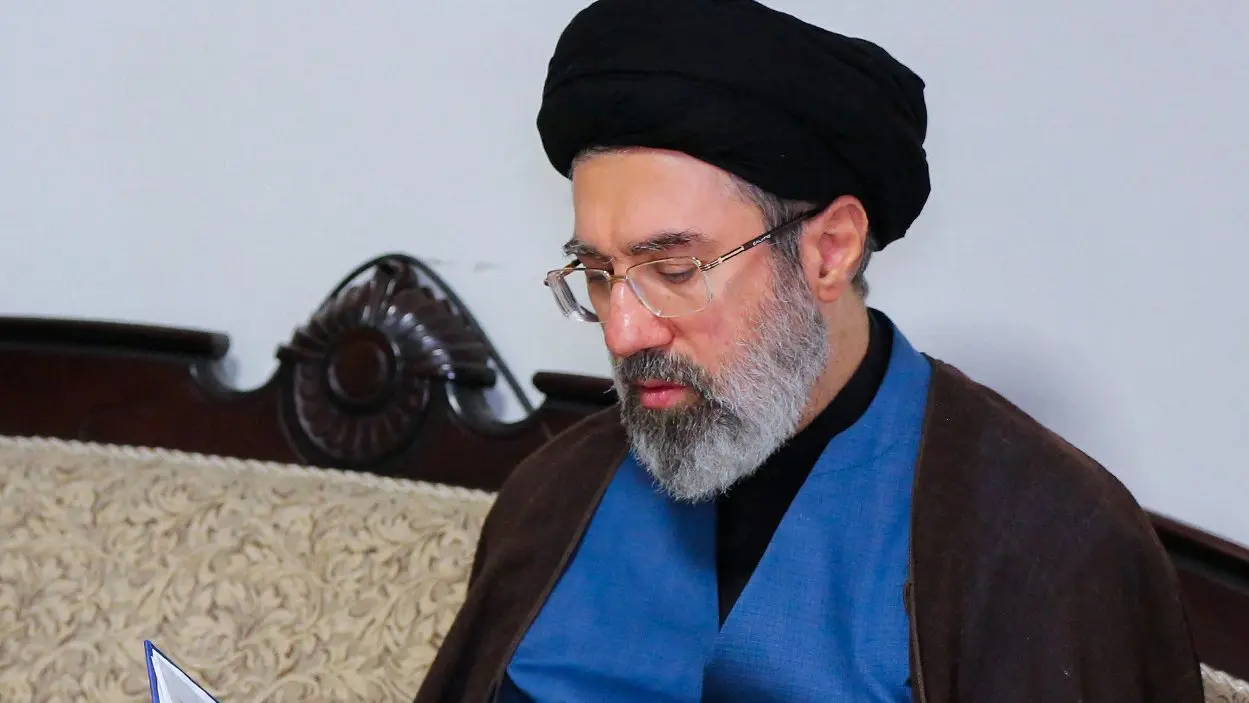
Mojtaba Khamenei, the second son of Iran's Supreme Leader Ayatollah Ali Khamenei, visits Hezbollah's office in Tehran, Iran, October 1, 2024. Office of the Iranian Supreme Leader/WANA (West Asia News Agency)/Handout via REUTERS ATTENTION EDITORS - THIS PICTURE WAS PROVIDED BY A THIRD PARTY.
(Tehran, Iran) – Iran’s political future took a dramatic turn on Tuesday as opposition media outlets reported that Mojtaba Khamenei, the eldest son of the late Supreme Leader Ali Khamenei, has been selected to assume the country’s most powerful post.
According to Iran International, Mojtaba was chosen by the powerful Assembly of Experts, the clerical body responsible for appointing and overseeing the Supreme Leader. Iranian state media had not confirmed the development as of Tuesday afternoon, though the report quickly circulated through Israeli and Western outlets.
The reported decision comes just days after a devastating strike that killed senior Iranian leadership figures, including Ali Khamenei. Early speculation suggested Mojtaba himself may have been among those killed, but those reports now appear to have been unfounded.
A Controversial Succession
Mojtaba Khamenei, 56, has long been viewed by analysts as a behind-the-scenes power broker with close ties to the Islamic Revolutionary Guard Corps (IRGC), the elite military force that wields enormous influence inside Iran. Though he never held a formal government title, he was widely believed to play a significant advisory role in his father’s administration.
The United States sanctioned Mojtaba in 2019, citing allegations that he acted on behalf of his father to consolidate control and influence political processes within the country.
If confirmed, his elevation would mark a striking moment in Iran’s post-revolutionary history. The Islamic Republic emerged from the 1979 overthrow of the Shah, rejecting hereditary monarchy. A father-to-son succession at the apex of power could be viewed by critics as contradicting that revolutionary ethos.
Power Struggle Amid War and Instability
Iran has been operating under an interim leadership council composed of senior regime figures who survived the recent strikes. In the days since, speculation has swirled over who would ultimately consolidate authority.
The reported appointment comes as the country faces mounting internal instability and continued military exchanges across the region. Missiles and drone strikes have intensified, with Tehran retaliating against U.S. and allied targets while bracing for further escalation.
Whether Mojtaba Khamenei’s reported selection stabilizes the regime — or deepens internal divisions — remains uncertain. Confirmation from official Iranian channels will likely determine how quickly the transition solidifies and how the broader region reacts.