






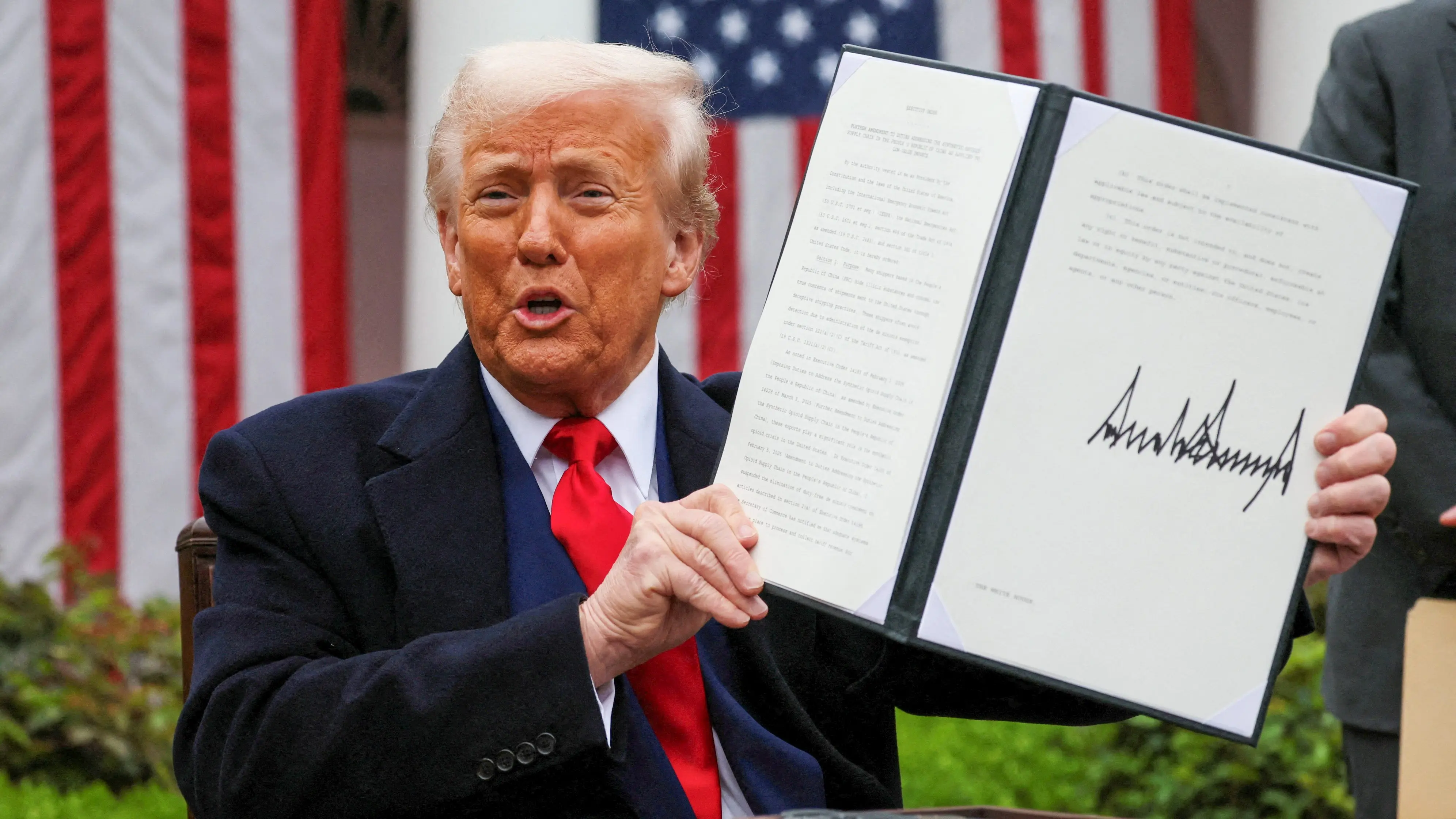
U.S. President Donald Trump holds a signed executive order on tariffs, in the Rose Garden at the White House in Washington, D.C., U.S., April 2, 2025. REUTERS/Leah Millis/File Photo
(Washington, DC) – The U.S. Supreme Court dealt President Donald Trump a major setback Friday, striking down his sweeping global tariff framework in a 6–3 decision that reshapes the future of his trade agenda.
The ruling centers on Trump’s use of a 1977 emergency powers law to unilaterally impose broad “reciprocal” tariffs on nearly every country — a cornerstone of his economic strategy since returning to office.
The Court’s Ruling
Writing for the majority, Chief Justice John Roberts stated that the Constitution “very clearly” assigns Congress the power to levy taxes — including tariffs.
“The Framers did not vest any part of the taxing power in the Executive Branch,” Roberts wrote.
The majority included Roberts and two Trump appointees — Justices Neil Gorsuch and Amy Coney Barrett — along with the court’s three liberal justices.
Justice Brett Kavanaugh authored the dissent, joined by Justices Clarence Thomas and Samuel Alito. Kavanaugh argued the tariffs were lawful under the statute in question, writing: “The tariffs at issue here may or may not be wise policy. But as a matter of text, history, and precedent, they are clearly lawful.”
Can Trump Still Impose Tariffs?
Yes — but not under the fast-acting emergency authority he relied on.
Administration officials say they plan to explore alternative trade laws to preserve parts of the tariff framework. However, those statutes typically require longer timelines and more procedural hurdles, limiting how quickly and aggressively tariffs can be imposed.
The Economic Impact
The Congressional Budget Office previously estimated Trump’s tariffs would have a $3 trillion economic impact over the next decade. Businesses across industries — from small manufacturers to large retailers — have collectively paid billions in import duties.
The court did not address whether companies are entitled to refunds. Kavanaugh acknowledged in his dissent that the refund process could be a “mess,” given the billions already collected.
Business Reaction
Small business coalitions and trade policy analysts welcomed the decision, calling it a win for importers and the broader U.S. economy. Advocacy groups are now pressing for a fast and automatic refund process for tariffs already paid.
Meanwhile, U.S. stock markets remained relatively steady in early trading following the ruling, suggesting investors had partially priced in the possibility of the court curbing executive tariff power.
A Blow to Executive Authority
The decision marks the first major element of Trump’s renewed agenda to be squarely rejected by the nation’s highest court — a court he helped shape during his first term.
In recent months, Trump had secured short-term victories on the court’s emergency docket related to executive authority. Friday’s ruling, however, delivers a significant limitation on presidential power in the trade arena.
The White House did not immediately comment following the decision.
What happens next will depend on whether the administration pivots to alternative legal authorities — and whether Congress steps in to codify or block future tariff efforts.
For now, the Supreme Court has made one thing clear: tariffs, as taxes, belong to Congress.