



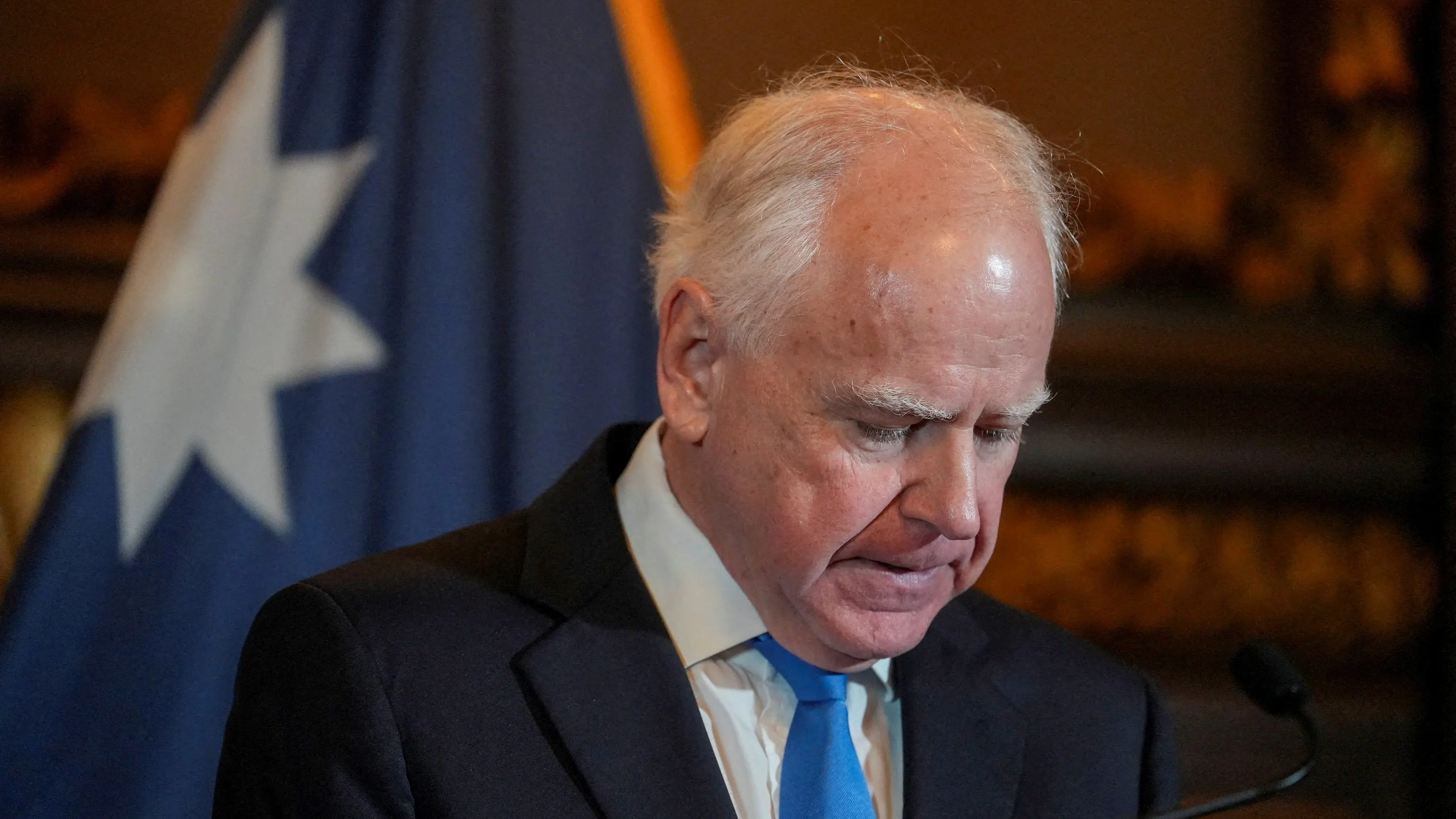
Minnesota Governor Tim Walz speaks to reporters after he announced that he would not seek reelection, at the Minnesota State Capitol in St. Paul, Minnesota, U.S. January 5, 2026. REUTERS/Tim Evans TPX IMAGES OF THE DAY
(Minneapolis, Minnesota) – Minnesota Gov. Tim Walz is facing mounting criticism after forcefully condemning the fatal ICE shooting of Renee Nicole Good, declaring that she was “dead in her car for no reason whatsoever.” The problem for Walz, critics say, is that Minnesota law already answers that question- and he personally signed it into law. In 2020, Walz approved reforms to Minnesota Statute §609.066, which explicitly allow law enforcement officers to use deadly force if a vehicle accelerates toward them and poses an immediate threat, without requiring officers to wait until impact.
That statute is now central to the Minneapolis shooting, where federal officials allege Good attempted to drive toward an Immigration and Customs Enforcement officer during an enforcement operation. DHS and the Trump administration have maintained the officer acted in self-defense, describing the vehicle as a deadly weapon, language that mirrors the very standard embedded in Minnesota law. Under the statute Walz signed, officers may act based on “apparent intent and proximity,” a threshold designed to prevent officers from being run down while hesitating for certainty.
Yet in the aftermath, Walz struck a dramatically different tone. Calling the shooting “preventable” and “unnecessary,” the governor publicly disputed federal accounts and ordered the Minnesota National Guard to prepare for deployment amid escalating protests. His remarks stood in stark contrast to the law he once defended as a necessary tool for officer safety. To critics, the shift looks less like principled leadership and more like political repositioning under pressure from activist groups and a hostile media climate.
The irony has not gone unnoticed. While Walz now suggests there was “no reason” for deadly force, Minnesota law- on the books because of his signature, was written for precisely this scenario. If a vehicle is perceived as accelerating toward an officer, deadly force is legally justified. Whether the facts ultimately support federal claims remains under investigation, but the legal framework Walz endorsed leaves little ambiguity about how officers are trained to respond.
As investigations by the FBI and Minnesota authorities continue, the episode underscores a broader tension in modern politics: leaders eager to distance themselves from outcomes produced by the laws they championed. For Walz, the shooting has become more than a tragic incident, it is a political test of whether accountability applies only to law enforcement, or also to the lawmakers who set the rules they are now condemning.