




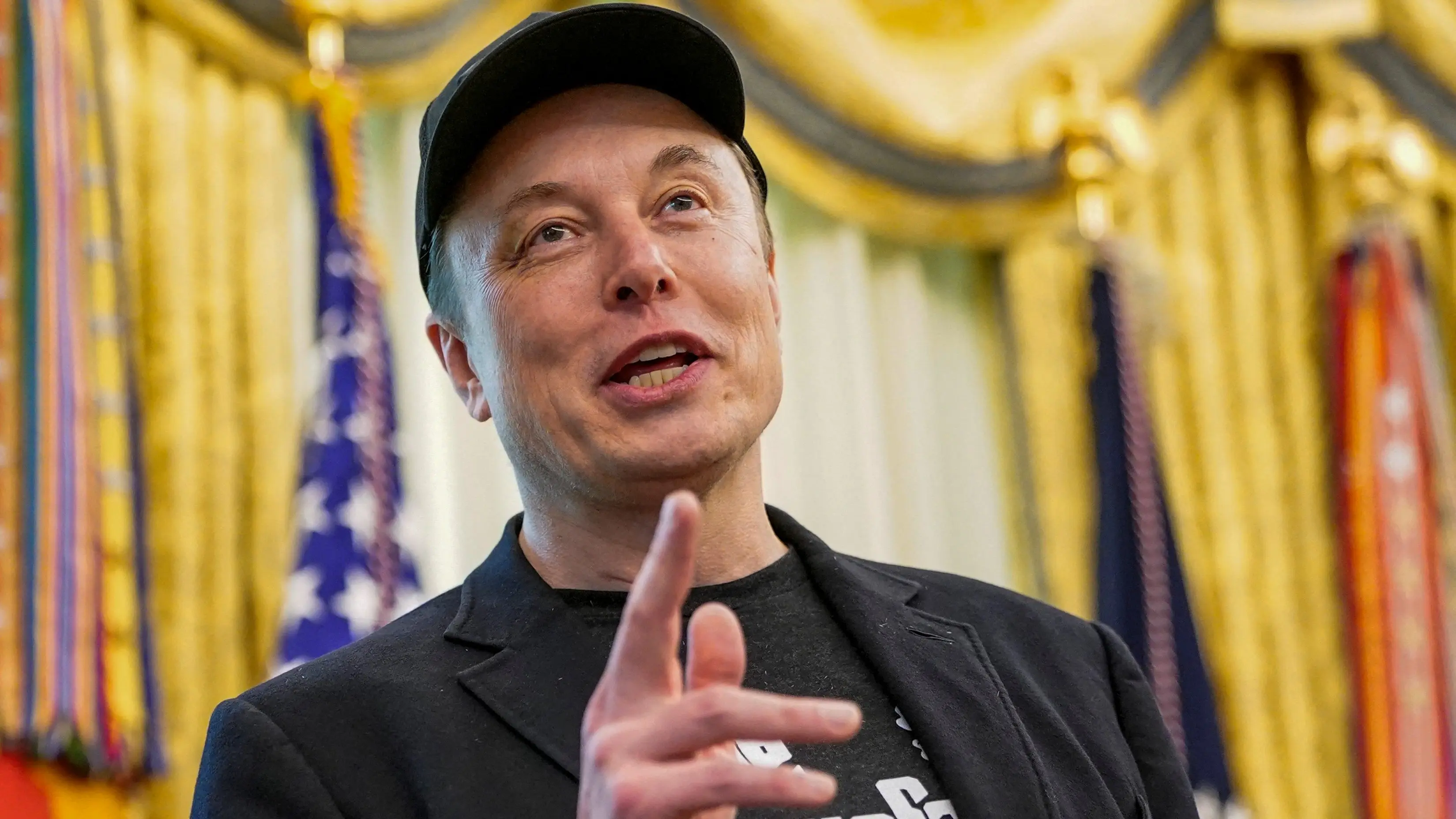
Elon Musk speaks during a press conference with U.S. President Donald Trump (not pictured), at the White House in Washington, D.C., U.S., May 30, 2025. REUTERS/Nathan Howard
(New York, New York) – Elon Musk once again laid out his vision of the future: unstoppable AI, inevitable disruption, and a world where human institutions simply can’t keep up. Musk warned that society is heading toward what he described as a “supersonic tsunami” of artificial intelligence- one that governments are powerless to slow, regulate, or meaningfully understand.
According to Musk, that’s not necessarily a problem. In his view, the only real option left is participation. Slowing AI development is “pointless,” he said, because global competitors won’t cooperate anyway. Instead, Musk argued that tech leaders should push forward as fast as possible and hope to steer outcomes in a “good direction.” What that direction looks like is ambitious: AI surgeons outperforming the world’s best doctors within three to four years, humanoid robots scaling into the billions, and medical care becoming so cheap and precise that today’s healthcare systems are rendered obsolete.
Human labor, meanwhile, appears to be a temporary feature. Musk suggested that professions requiring years of education, including medicine- will soon be unnecessary, even describing medical school as “pointless” outside of social reasons. Governments, he said, will be too slow to respond to the upheaval, leaving them with only one viable tool: issuing people money to “keep the peace” while AI systems transform the economy underneath them. The details of how society functions in the meantime were largely waved away.
As the discussion continued, Musk leaned further into abstraction. Humanity was described as a “biological bootloader” for digital superintelligence- useful for now, but ultimately transitional. Disruption was treated less as a social crisis and more as an engineering challenge, one that will resolve itself once intelligence, compute, and electricity scale high enough. Any discomfort along the way was framed as the unavoidable cost of progress.
For Musk, the future is exhilarating: unlimited intelligence, no scarcity, and machines solving problems humans can’t even comprehend. For everyone else, the vision sounded less like reassurance and more like a reminder of how disconnected Silicon Valley’s optimism can be from everyday reality. Jobs, purpose, and stability were treated as legacy issues, bugs to be patched eventually.
The promised utopia may arrive someday. But listening to Musk describe it so confidently, while brushing past the human consequences in between, made one thing clear: the people building the future seem far less worried about living through it than the people who will have no choice but to.