





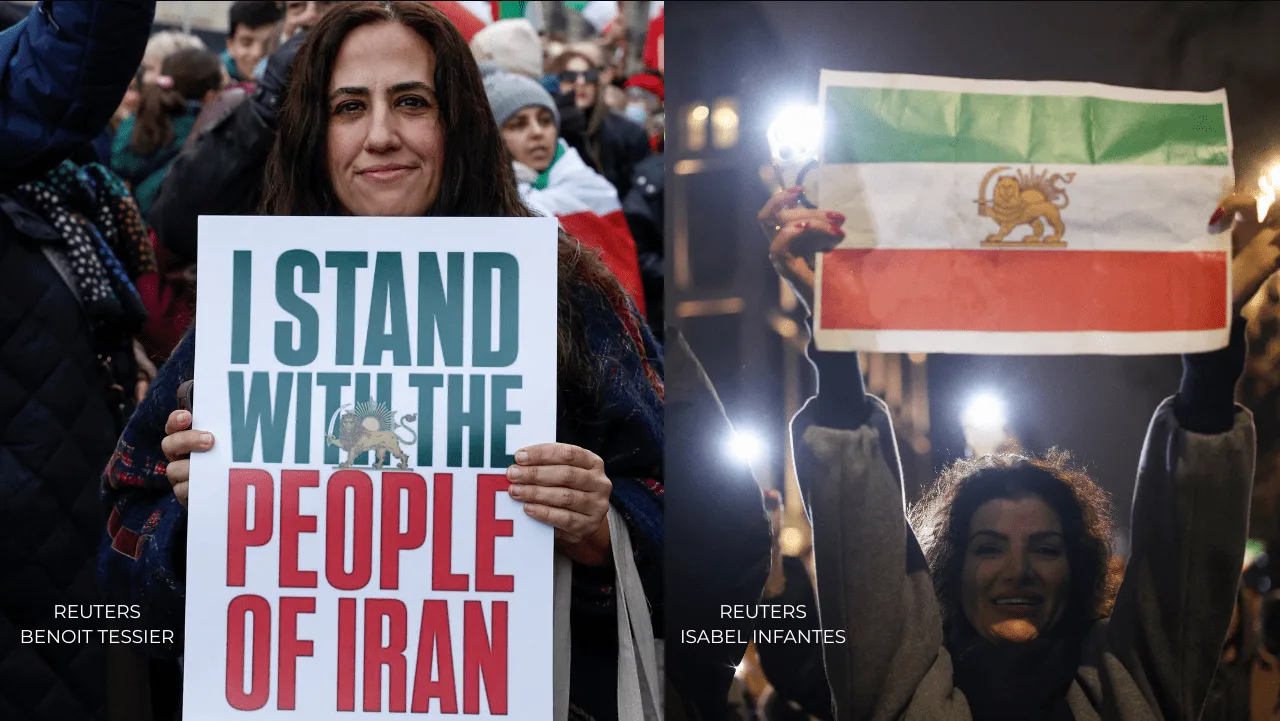
In these photos from Reuters, a woman holds a sign in support of the Iranian uprisings in Paris (left) and in London (right). January, 2026.
(New York, NY) – Dozens of people have been killed during the uprisings, and a full internet blackout has been imposed. Whatever the American political left thinks its doing with protests in places like Portland and Minneapolis is actually being accomplished on the streets of Iran — revolution. And while news reports will continuously tell you that the entire situation is rooted in economic collapse, it’s much deeper than that.
It’s true that value of the rial in terms of US dollars has plummeted. Shop keepers across Iran closed their doors in late December and took to the streets to participate in protest. There is a sense that the Islamic Republic’s leaders have failed its people, bringing on inflation, embarrassing military defeats, and a general decline in standard of living. Yet the situation goes back much further than anything so recent — and it’s why the entire situation in Iran is one of if not the biggest threat the Islamic Republic has faced since its founding in 1979.
Since the overthrow of Iran’s last Shah, Mohammad Reza Pahlavi, the nation has been ruled by Muslim clerics, including the current Supreme Leader of Iran, Ali Khamenei. But amid the current uprisings, Reza Pahlavi, the 65-year-old exiled son of the Shah, has emerged as a prominent opposition figure. He’s lived outside Iran since before the 1979 revolution, and recently has issued calls urging protesters to join demonstrations, take over cities, and push for democratic transition.

Pahlavi has positioned himself as a national leader. Public chants have broken out in support of him. That said, his role is debated: some see him as a unifying force, while critics argue he obviously can’t lead from exile.
The timeline for the most recent uprisings is as follows: on December 28, large crowds began to gather in cities, and markets effectively came to a halt as businesses shuttered. What may have began as an economic protest has since spread to calls to overthrow the Islamic Republic. Reports began to emerge that Supreme Leader Khamenei was making contingency plans, should he need to leave the country. Then, on January 8, a full internet and phone service blackout was imposed on the country. By then demonstrations had spread to nearly all provinces, including major cities like Tehran, Shiraz, Mashhad, Karaj, Kermanshah, Ahvaz, Tabriz, and others. Over that time, millions have reportedly taking to the streets.
Reporting, which has been largely done by foreign or internet-based journalists, has recounted a brutal response from the Islamic regime in the face of these uprisings. Security forces, including IRGC and Basij, have reportedly opened fire on demonstrators, resulting in dozens to hundreds of deaths. Estimates vary: Amnesty International reports at least 28 killed (including children) across 13 cities; other human rights groups cite up to 490 deaths and over 10,000 arrests in the past 15 days. There are also specific stories being told, such as that of 15-year-old Mustafa Fallahi, who was shot in the head. With full blackouts in places like Marvdasht, some killings are going unreported. Videos and reports show escalating violence, arrests, and forced confessions.

This uprising is widely viewed as one of the biggest challenges to the regime since its founding in 1979. It meets all the key conditions for potential revolution: economic collapse, military humiliation (including ongoing conflicts with Israel and the US military’s effective bombing campaign against Iran’s nuclear facilities), erosion of legitimacy, and external pressures like sanctions.Analysts note the regime is under unprecedented strain, with protests shifting from economic demands to explicit calls for overthrow. While some say it’s on the edge of collapse, others argue it’s battered but resilient, interpreting survival as a sign of endurance amid risks.
Mainstream media reports have centered their focus on economics being the primary catalyst, with the rial collapsing to historic lows and inflation soaring. One US dollar is worth around 1.4 million rial. Sanctions imposed by foreign governments have also exacerbated shortages in Iran. The Middle Eastern country also faces high levels of unemployment, and outright poverty.
Mainstream media reports have centered their focus on economics being the primary catalyst, with the rial collapsing to historic lows and inflation soaring. One US dollar is worth around 1.4 million rial. Sanctions imposed by foreign governments have also exacerbated shortages in Iran. The Middle Eastern country also faces high levels of unemployment, and outright poverty.

Protests that began over these issues but quickly evolved into political demands. The regime blames external sanctions, but critics point to internal mismanagement, corruption, and the costs of regional conflicts as key contributors to the crisis. As evidenced by slogans such as “Woman, Life, Freedom” there’s also a broad rejection underway of the Islamic Republic’s theocratic rule. Secular democracy in line with the region’s proud Persian history seem within reach. There’s an undercurrent of reclaiming Persian identity over Arab-influenced Islamism, as seen in support for pre-revolutionary monarchy and opposition to the regime’s religious ideology.
Still, an accurate portrayal would note it’s definitely not purely cultural. The core driver is anti-regime sentiment fueled by repression, though Persian nationalism plays a role in framing the opposition. For example, Pahlavi has appealed to the historical concept of Iranian monarchy.
Here in the United States, President Trump and his advisors have reportedly been mulling a potential military response to the ongoing communications blackout and reported attacks/killings of protesters. Trump’s openly warned the Islamic Republic that it’s leaders will face consequences if they act inappropriately during this period. And given Nicolas Maduro now cools his heels inside a New York City jail cell — that’s hardly hot air.
LISTEN 🎧 to more on the developing situation in Iran:
AND READ 📚 about the Iranian government’s $7 move…