




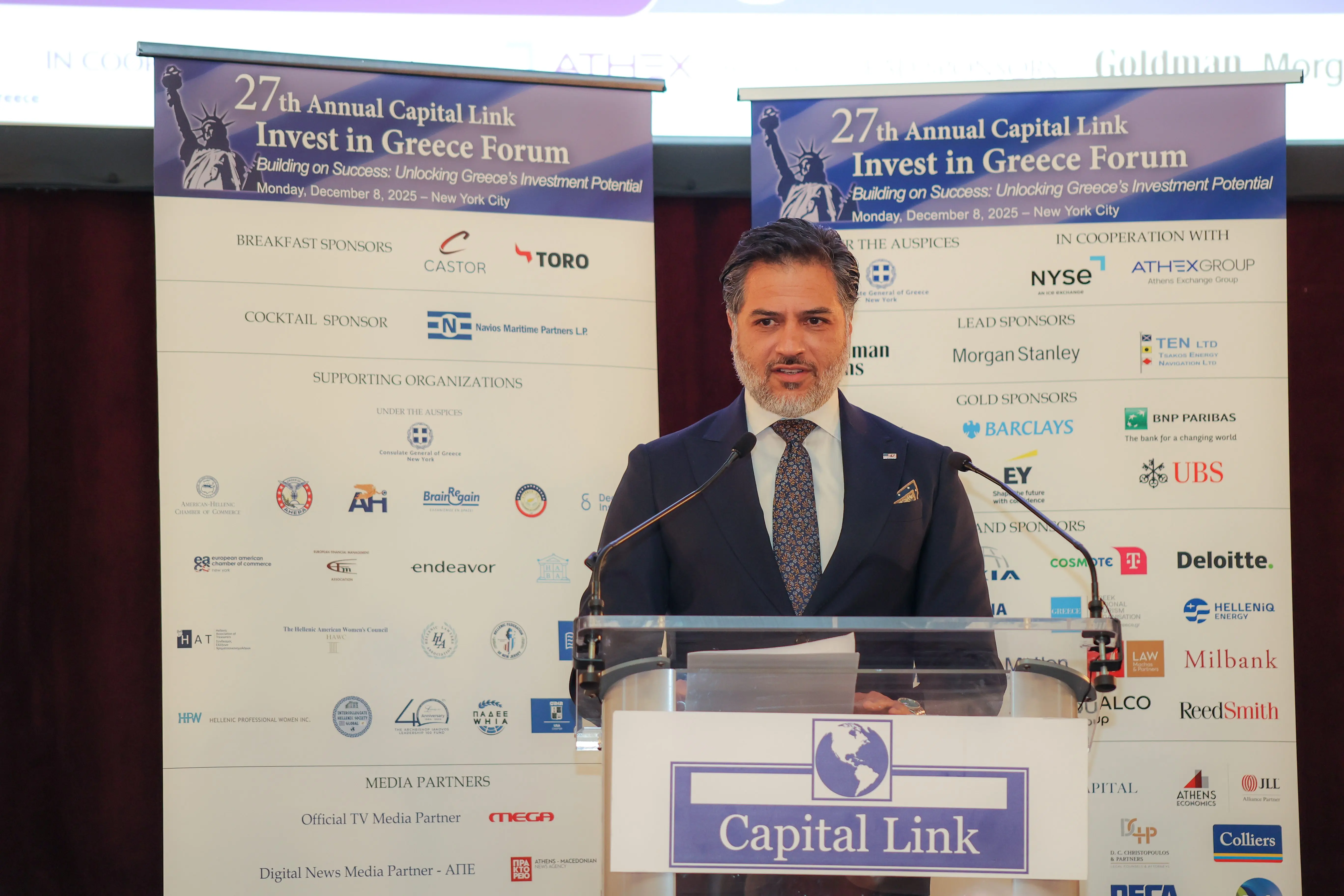
joshua-volz-dept-deputy-asst-secratery-of-us-dept-of-energy
NEW YORK, NY- The 27th Annual Capital Link Invest in Greece Forum, held on December 8 at the Metropolitan Club in New York City, offered a clear view into how the United States increasingly sees Greece, not only historically, but as a strategic partner with growing importance across energy, infrastructure, and regional stability. Organized in cooperation with the New York Stock Exchange and the Athens Exchange Group and held under the auspices of the Consulate General of Greece in New York, the Forum brought together senior officials, investors, and business leaders focused on the evolving U.S.-Greece relationship and its economic implications.
That perspective came into sharp focus during the luncheon keynote delivered by Joshua Volz, Deputy Assistant Secretary for Europe, Eurasia, Africa, and the Middle East at the U.S. Department of Energy. Volz spoke less about abstract diplomacy and more about practical alignment how Greece’s geography, capabilities, and political direction have elevated its role in U.S. strategic planning, particularly in the energy sector.
Volz emphasized that recent agreements between American and Greek companies reflect a deeper shift in transatlantic priorities. Energy, he noted, has become both an economic and geopolitical instrument, and Greece now sits at the center of efforts to provide Europe with alternatives to coercive supply dependencies. U.S. liquefied natural gas, he explained, is not simply a commodity, but part of a long-term partnership built on shared interests and mutual trust.
According to Volz, Greece’s advantages are tangible. Its position at the intersection of Europe, the Eastern Mediterranean, and the Balkans, combined with technical expertise and a globally influential shipping industry, places the country in a unique position to support Europe’s transition away from Russian energy. He pointed to the development of a northbound “vertical corridor” of infrastructure as an example of how Greece can function as both a gateway and a stabilizing force for the wider region.
At the same time, Volz acknowledged the scale of the challenge ahead. Europe’s commitment to rapidly eliminating Russian energy resources, he said, will require close coordination between governments and the private sector, and a willingness to move faster than traditional models allow. Success, he argued, depends on using energy to foster cooperation and economic growth rather than leverage and division.
The message was reinforced by Kostis Hatzidakis, Vice President of the Government of the Hellenic Republic, who outlined why Greece has become increasingly attractive to American investors. He highlighted opportunities in infrastructure and connectivity, defense and advanced technology, research and artificial intelligence, and higher education sectors where reform, stability, and incentives have aligned.
Together, the remarks underscored a shared conclusion: Greece is no longer viewed simply through the lens of recovery, but as a reliable U.S. partner with a strategic role in shaping Europe’s energy security and economic future.
For more: https://www.youtube.com/watch?v=bqrZ7encO-A