






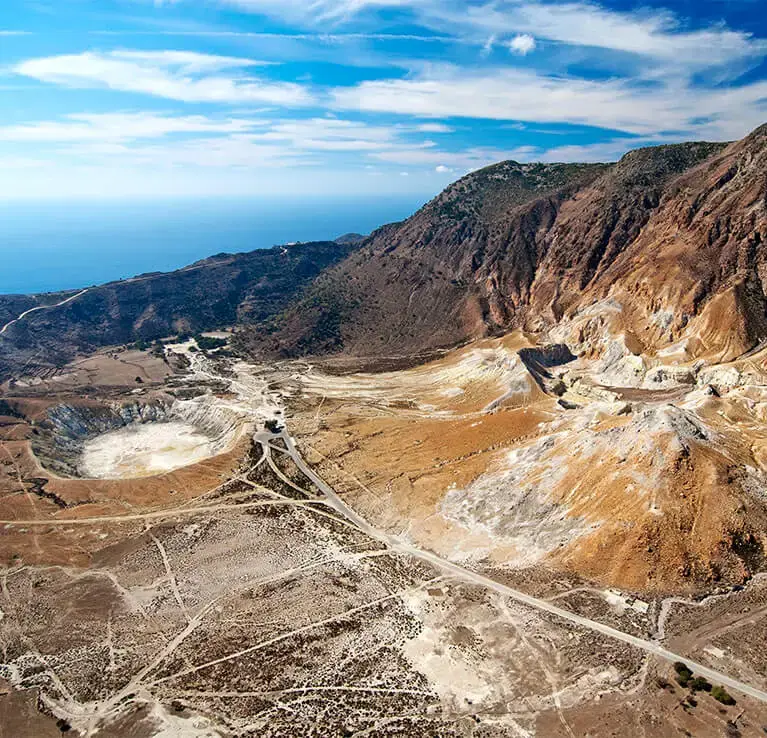
nisyros-volcano-visitgreece-gr
Tucked quietly between Kos and Tilos in the Dodecanese, Greece, the island of Nisyros does not shout its beauty, it silently whispers it, as the eye stretches over the island’s views. Roughly circular, the small island’s shape and character have been molded by millennia of volcanic activity. Walking its slopes is like turning pages in a geological memoir: jagged lava flows, pumice-stone houses, caldera cliffs and sulfur-tinged springs all remind you that beneath these tranquil villages lies one of Greece’s youngest volcanoes, like the ones on Milos and Santorini. (visitgreece.gr)
For travelers seeking the charm of a “traditional” Greek island, modest crowds, local rhythms, whitewashed homes, panoramic sea views, with a twist of wild nature and ancient mystery, and authentic Greek cuisine, inspired by Italian influence, Nisyros delivers a rare experience.
The Volcano & Craters
The central feature of Nisyros is its caldera: a 3-4 km wide volcanic basin housing one of the world’s largest hydrothermal craters, known as Stefanos Crater. Visitors can actually walk down into this surreal lunar-like crater, with the unmistakable smell of sulfur and steam vents, for an experience few islands can rival. For a more solitary experience, the lesser-visited Polyvotis Crater offers similarly dramatic volcanic terrain with fewer tourists. (visitgreece.gr)
Across Nisyros, volcanic geology has left its mark: from lava-formed cliffs and pumice-stone soils to black and grey sands, it’s as much a geologist’s outdoor museum as a holiday escape. (visitgreece.gr)
Ancient Footprints: History & Settlements
Near the harbor village of Mandraki lies Paliokastro, an ancient acropolis whose massive cyclopean walls date back to antiquity. Walking there, you tread the stones that have witnessed millennia of island life. (Wikipedia)
The island’s history spans from prehistoric inhabitation to Roman occupation, which stretched to medieval crusaders and then Ottoman occupation, each culture contributing to Nisyros’s unique cultural tapestry. (Wikipedia)
For deeper context, the local Volcanological Museum of Nisyros (in the village Nikia) offers geological displays and artifacts that trace the island’s volcanic and human past. (visitgreece.gr)
Villages, Beaches & Island Rhythm
Mandraki, the island’s port town, exudes laid-back island charm: narrow alleys, white-and-multicolored houses built from local volcanic stone, a relaxed seaside ambiance, and easy access to ferries and local amenities. (visitgreece.gr)
Nikia, perched 400 m above sea level, feels like a picture-postcard of the Aegean: white houses, red-tiled roofs, pastel doors, and a central square (the “Porta”) with a pebble mosaic, regarded by many as one of the island’s loveliest corners. (visitgreece.gr)
The village of Emporios, high on the slopes, offers sweeping views of the caldera and sea, a peaceful retreat for those who want quiet, greenery, and a sense of Nisyros living away from the bustle. (visitgreece.gr)
Nisyros may not boast expansive tourist-resort beaches, however that’s part of its charm. Instead, you’ll find secluded coves, rocky shores and a few sandy retreats.
Notable beach spots include Lies Beach a cluster of small sandbanks set in serene coves, and Hohlaki Beach, nestled under a monastery in Mandraki, ideal for a quiet swim with scenic views.
For a more social or “local tavern + sea” vibe, the sandy beach near the fishing village of Pali is charming, modest, and promises a great traditional Greek meal.
Traditional Local Taste-Nisyros’ Unique Cuisine
Nisyros’ cuisine reflects the island’s crossroads history, where Aegean traditions met influences from Asia Minor, the Eastern Mediterranean, Venetian empire, and the nearby Dodecanese trade routes. Local cooks have long blended simple island ingredients, chickpeas, capers, garden herbs, sheep’s milk cheese, with the flavors of various spices brought by merchants and travelers. Dishes like Pithia, the island’s rustic chickpea fritters, something like a Greek Falafel, carry a clear Anatolian imprint, and the delicious Kapama, a slow-cooked meat stew, or sometimes lamb, simmered with tomato, onions, cinnamon, allspice, bay leaves, and local wine, echoes older Levantine spice traditions found throughout the region, paired with skordalia (Garlic spread) with almonds, once connected to seafaring exchanges with medieval Venetian ports, shows how outside cultures shaped local tables. Today, these recipes remain central to Nisyros’ identity, offering visitors a taste of an island that absorbed foreign influences without losing its own character. (visitgreece.gr)
Don’t skip what Greece is known best for: fresh seafood, the island’s local vegetables, seasonal produce, often served in tavernas lining all the narrow streets and beach fronts or perched above the caldera, where you eat with the beautiful views.
Desserts also include the traditional Greek loukoumades, the Greek honey-drenched delight like a zeppole or donut, this is typically served at island festivals and local feasts.
(Visit Greece) Nisyros; Hellenic National Tourism Organization; Dodecanese culinary research archives.)
A Calendar of Traditions: Festivals & Village Life
Because Nisyros moves with “island” time, its rhythms are deeply tied to tradition, often centering on religious feast days and village gatherings, not tourist-oriented events. A few highlights to try and catch while visiting:
The biggest annual national Christian celebration of the Virgin Mary occurs on the 15th of August, at the church of Panagia Spiliani: locals begin preparations early, and visitors are welcomed to join in feasts, church services, and communal revelry. (visitgreece.gr)
On the 14th of September, Mandraki comes alive for the feast of the Holy Cross (Stavros), with local dishes and wine, a true taste of island tradition and hospitality. (visitgreece.gr)
For many visitors the magic isn’t only the sights, it’s being welcomed into the island’s rhythms: evening tavernas, local chatter, church bells, a calming pace that seems hushed compared to larger tourist hubs.
Travel Tips & What Makes Nisyros Special
Getting there & around: Ferries connect Nisyros to major ports (including Athens/Piraeus) as well as nearby islands. Once on the island, a rental motorbike or car, or local bus service, taxis, help reach remote villages and crater zones.
Accommodation & Pace: Forget high-rise resorts and hotels or jumping nightlife. On Nisyros, comfortable guesthouses, seaside tavernas, simple cafes, and local rhythms define the stay, ideal for travelers who appreciate calm, authenticity and natural beauty.
Soulful Experience
Nisyros is not a postcard island. It is sweeter and subtler than that, with a sense of lazy days, soft sea breezes and sulfur-tinted earth, whitewashed villages, perched over the volcano’s caldera, beaches with super serene quiet coves, and meals that taste of land, sea, and tradition. It is an island for the curious: those who travel not just to see, but to feel a Greece lost in time, to dive into the blue sea, wander narrow alleys, step into steaming craters, sit down at a taverna at dusk, watch goats climb volcanic slopes, and listen to church bells echo over the sea.
If your travels take you to Greece, and you want something unforgettable, and deeply soulful, Nisyros is peacefully waiting for you.
Source: (visitgreece.gr)
Picture Credit: (visitgreece.gr)