





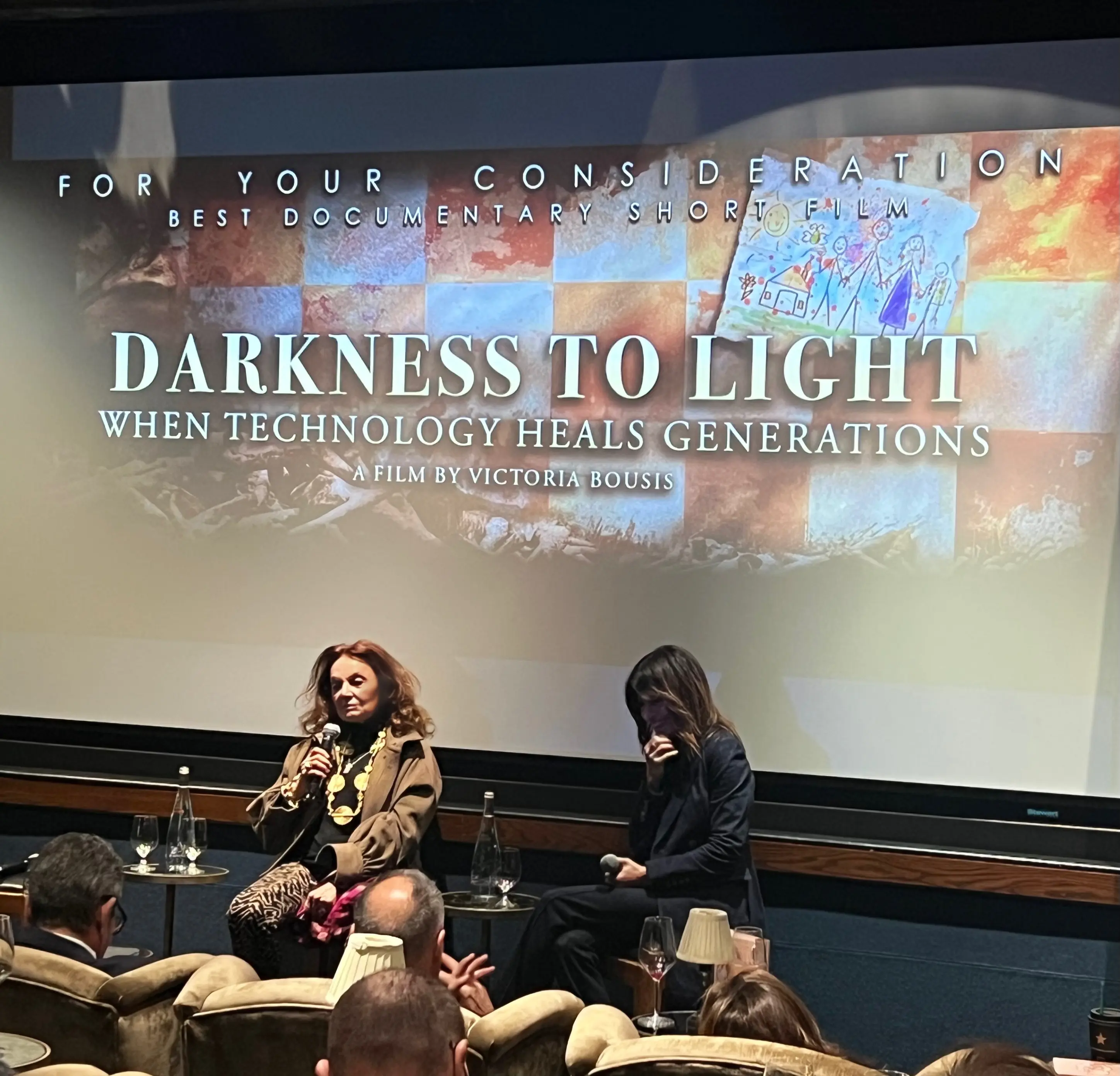
darkness-to-light-screening-soho-house-new-york-ny-diane-von-furstenberg-victoria-boussis-png
New York, NY–In the documentary, Darkness to Light: When Technology Heals Generations, filmmaker and technologist, Victoria Bousis, transforms memory into an immersive experience that bridges past and present, trauma and transformation, grief and grace through Virtual Reality story telling.
The documentary is inspired by Bousis’s acclaimed Rolling Stone article, “If Tiles Could Speak, They Would Scream” and her award-winning VR experience, “Stay Alive My Son”, reimagines how technology can serve as both witness and healer. At its core, lies one haunting question: Can technology help us heal what has never been shared?
“This film began as a promise to the father and author of the book “Stay Alive My Son”, Yathay Pin, who hopes to find his son through the book, and now through this film” says Boussis.
The film held a private screening at Soho House New York, and presented by Victoria Boussis’s close friend and world-renowned fashion designer Diane von Furstenberg. In her introduction, von Furstenberg reflected on her personal connection to the film’s themes, sharing that her own family survived the Holocaust, an experience that deepened her empathy for stories of remembrance, resilience, and healing.
The Story: From Silence to Connection
At the heart of the film, we find a 14-year-old Cambodian girl, who watched the story patiently through the VR lenses, when others couldn’t bare the experience. The little girl embodies a new generation, confronting the unspoken legacy of their ancestors. Through virtual reality, she steps into the story of Yathay Pin, a father who survived the Khmer Rouge, a man forced into an impossible choice amid terror, separation, and guilt.
As she walks through his memories, his physical prison and his psychological experience, and loss of his son, generations meet across time. Through the headset, she witnesses his anguish, his endurance, and ultimately, his atonement. What follows is not just an act of remembrance, but of rebirth and forgiveness, a journey from inherited silence toward collective healing by storytelling.
Memory and Healing
The documentary, narrated by Victoria Boussis, as a deeply personal tribute, Darkness to Light, intertwines vérité filmmaking, archival footage, survivor testimony, and behind the scenes glimpses of the VR reconstruction process. It’s both lyrical and raw a cinematic meditation on the intersections of technology, trauma, and human empathy.
Bousis’s narration bridges the intimate and the universal, reflecting on how immersive media can make history tangible for younger generations who never lived it, yet still bear its emotional imprint.
“I met a man and gave him my promise, and this man is someone I grew to love to admire and make my family, my promise to him was that ”I would never allow the loss of your family to go in vein, I would never allow the story of your country and the story of so many others to be silenced again”, said Bousis at the screening
Some Historical Context: Cambodia’s Unhealed Wounds
From 1975 to 1979, Cambodia was ruled by the Khmer Rouge, a revolutionary communist regime led by Pol Pot. Inspired by the ideas of Maoist China,yet driven to a far more extreme vision, the Khmer Rouge sought to build a classless agrarian society. In pursuit of that goal, they abolished money, religion, property, education, and even family life, believing that only through destruction could a “pure” nation be reborn.
When Phnom Penh fell to Khmer Rouge forces in April 1975, the capital’s residents, teachers, doctors, shopkeepers, children, and the elderly were forced at gunpoint into the countryside. Entire cities were emptied within days. Millions of people were condemned to endless field labor, starvation, and disease in vast rural collectives. Anyone with an education, foreign connections, or suspected disloyalty was executed in secret prisons such as Tuol Sleng (S-21). Within four years, more than 1.7 million Cambodians nearly one-quarter of the nation’s population had perished through forced labor, famine, or execution.
The Khmer Rouge’s campaign was not only political but cultural. By erasing artists, scholars, and spiritual leaders, it severed Cambodia’s ancient continuity and left generations struggling to reclaim identity. Families that survived carried invisible scars, and many children grew up in silence, their parents unable to speak of what had happened.
(Historical References): ( U.S Holocaust Memorial Museum BBC History, Yale Cambodia Genocide Program)
While films such as The Killing Fields and S-21: The Khmer Rouge Killing Machine, have documented these atrocities through testimony and archival record, Darkness to Light offers a new way to remember. Through the sensory depth of virtual reality, the film invites viewers not merely to learn about history but to enter it feeling, for a moment, the human weight behind the numbers. It transforms remembrance into empathy, ensuring that Cambodia’s unhealed wounds are neither forgotten nor repeated
Technology as Empathy
In Bousis’s vision, virtual reality is more than a storytelling tool, it’s a vessel of empathy. Viewers are invited to “be present “inside the memories of a father who lost his son to the regime, and what he, his family, and a country endured: to feel the emptiness of separation, to see the faces of those lost, the torture endured by victims, and to experience the fragile hope of survival.
Through this immersive medium, the film challenges traditional notions of the remembrance of a brutal history, transforming passive observation into active compassion. Each frame becomes an act of atonement, a return to humanity through the language of light, sound, and shared emotion. A truly moving experience.
A Global Call to Remember
Darkness to Light is not simply a film and new technologies, it is a movement that invites dialogue between survivors, descendants, and global audiences. Its screenings are envisioned as immersive acts of remembrance: candlelight vigils, educational forums, and interactive exhibits that honor resilience. By blending innovation and memory, Boussis shows that healing is not about forgetting it’s about bearing witness together.
Closing Reflection
Victoria Bousis is a game changer, giving memory a new form, not confined to pages or screens, but awakened through shared human experience and the connective power of technology. The film stands as a testament to empathy’s ability to transcend time and transform pain into purpose. It reminds us that true healing begins when we dare to see, to feel, and to remember, not only to honor the past, but to guide future generations toward understanding the human cost of extreme ideology politics, war and the universal need to end its cycle of suffering. One would say after watching the documentary, that world leaders should experience this journey, as a reminder and awareness towards potential dangers posed to society.